
The electric heavy-duty truck drive system determines how a vehicle delivers power, how efficiently it uses energy, and which transport scenarios it can handle. For OEM engineers and fleet managers, choosing the right architecture is not just a technical decision—it directly affects operating cost, payload capacity, and long-term reliability.
Today, three main drive architectures dominate the electric truck market:
- Central direct drive
- Wheel-side motor drive
- Integrated electric drive axle (e-axle)
Each solution follows a different design philosophy. Their strengths and limitations also vary depending on the operating environment. Understanding these differences is essential when selecting the most suitable electric drive axle solution for a heavy-duty truck platform.
This article compares the three mainstream technologies and explains why the integrated electric drive axle is increasingly becoming the preferred solution for most commercial applications.
Central Direct Drive: A Transitional Solution from Diesel to Electric?
How Does a Central Drive Motor Work?
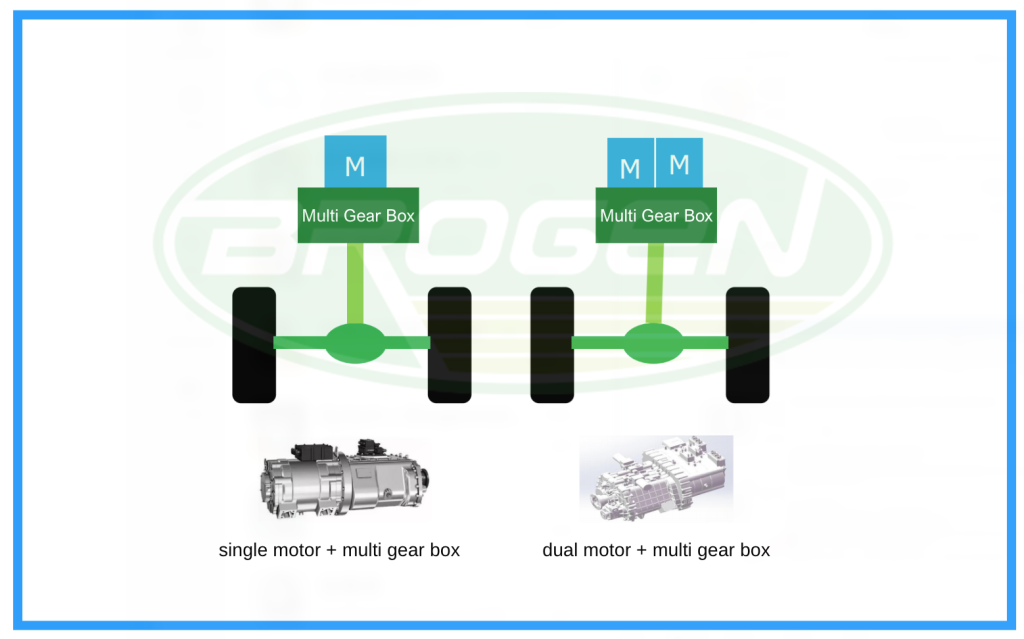
Central motor drive was the earliest architecture used in electric trucks. The concept is straightforward: replace the internal combustion engine with an electric motor while keeping the traditional drivetrain.
Power flows through the following path:
Motor → Driveshaft → Main reducer → Drive wheels
Because this layout is very similar to diesel trucks, it requires minimal changes to the chassis structure. Many early electric trucks and conversion models still use this architecture.
What Are the Advantages?
Mature and Familiar Technology
The biggest advantage is technical maturity. The drivetrain layout closely resembles that of conventional trucks, which makes maintenance easier for service technicians.
Spare parts are widely available, and maintenance systems are already established.
Lower Vehicle Cost
Most components—motors, driveshafts, and axles—are mature products within the supply chain. As a result, vehicles using this architecture generally have a lower purchase price.
Easy Driver Adaptation
When paired with an AMT transmission, the driving experience is similar to that of diesel trucks. Drivers can adapt quickly without additional training.
What Are the Limitations?
Despite its maturity, the central drive layout shows clear disadvantages in electric applications.
Transmission Efficiency Loss
Power must pass through multiple mechanical components before reaching the wheels. This creates transmission losses of roughly 8–10%.
Compared with an integrated electric drive axle, the vehicle may consume 10–15% more energy per 100 km.
Bulky Chassis Layout
Driveshafts and transmission components occupy valuable chassis space. This makes it harder to install larger battery packs or auxiliary systems.
Higher Vehicle Weight
A direct-drive layout can be 300–500 kg heavier than a truck with an electric drive axle. The extra weight reduces payload capacity and driving range.
Typical Applications
Central drive systems are mainly used in:
- Short-distance mining transport
- Port logistics operations
- Budget-sensitive fleet purchases
These scenarios prioritize low initial cost and simple maintenance rather than maximum efficiency.
Wheel-Side Motor Drive: The Ultimate Power Solution?
What Is Wheel-Side Motor Drive?
Wheel-side motor drive is a distributed architecture. Each drive wheel has its own electric motor.
Power flows directly from the motor to a wheel reducer, eliminating the driveshaft and central transmission components.
This layout allows precise torque control at each wheel and delivers exceptional traction performance.
Key Advantages
Exceptional Torque Output
Dual motors can generate extremely high torque. This makes wheel-side systems ideal for heavy loads and steep gradients.
High Transmission Efficiency
Because the drivetrain path is shorter, mechanical losses are reduced. Efficiency can reach around 94%.
Improved Traction Control
Independent motors allow the control system to adjust torque on each wheel. This improves stability on slippery or uneven surfaces.
Key Challenges
High System Cost
Wheel-side systems require multiple motors, controllers, and reducers. The total system cost can be 2–3 times higher than that of central direct-drive systems.
Complex Control Strategy
Coordinating multiple motors requires advanced control algorithms. Diagnostics and maintenance also require specialized expertise.
Reduced High-Speed Efficiency
Wheel-side systems perform best at low speed and high torque. At highway speeds, energy consumption can increase compared with an integrated electric drive axle.
Typical Applications
Wheel-side motor systems are mainly used in:
- Mining dump trucks
- Construction vehicles
- Heavy engineering transport
These vehicles require extreme torque and climbing ability.
Integrated Electric Drive Axle: Why Is It Becoming the Mainstream Choice?
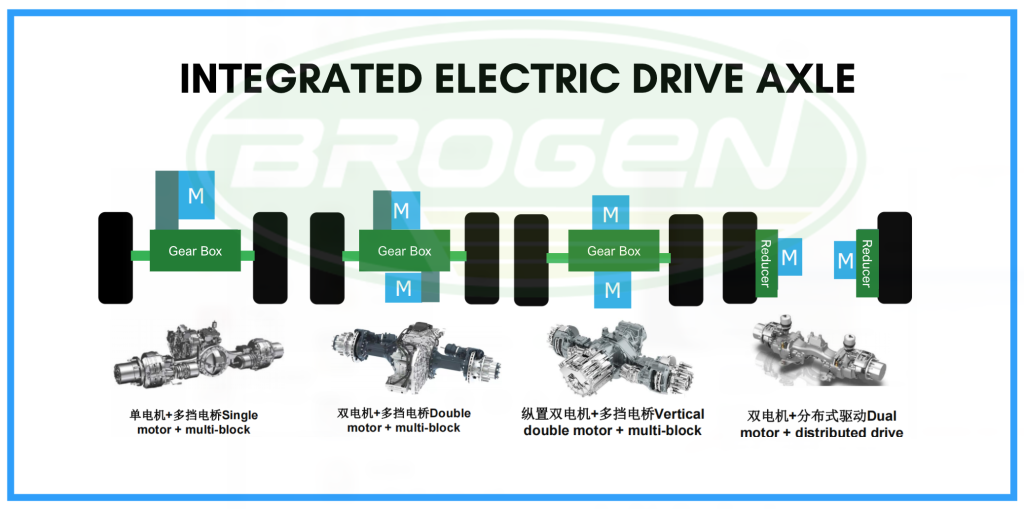
What Is an Integrated Electric Drive Axle?
The integrated electric drive axle represents the latest evolution of the electric heavy-duty truck drive system.
Instead of separating the motor, transmission, and axle, this design integrates key components into a single module:
- Motor
- Gear reducer
- Main reducer
- Differential
- Electronic control unit
This compact architecture eliminates the driveshaft and reduces the number of mechanical components.
The result is a highly efficient electric drive axle designed specifically for electric trucks.
Learn more about our electric drive axle solutions for commercial vehicles.
Key Advantages of an Integrated Electric Drive Axle
1. Higher Efficiency and Lower Energy Consumption
The integrated electric drive axle can achieve 95–96% transmission efficiency.
Compared with traditional central drive systems, this can reduce energy consumption by 10–15%.
For fleets operating long distances, this translates into significant energy savings over the vehicle’s lifetime.
Manufacturers such as Dongfeng and Yutong have already adopted integrated electric drive axle platforms in their latest electric truck models.
2. Lightweight Design and Higher Payload
By eliminating redundant components, the electric drive axle significantly reduces system weight.
Weight reduction can exceed 500 kg compared with traditional layouts.
Lower vehicle weight allows fleets to carry more cargo and increase transport efficiency.
3. Better Space Utilization
The compact design frees up valuable chassis space. Manufacturers can install:
- Larger battery packs
- Additional air tanks
- Auxiliary equipment
This flexibility is especially important for long-haul trucks.
4. Multi-Speed Intelligent Transmission
Many e-axle for trucks designs include a 2-speed or 3-speed gearbox.
Low gear provides strong torque for starting and climbing.
High gear improves efficiency during highway cruising.
This multi-gear system ensures the truck performs well across a wide range of driving conditions.
FAQs: Integrated Electric Drive Axle
1)Why are electric truck manufacturers adopting integrated e-axles?
The integrated electric drive axle combines several drivetrain components into a single module. This reduces mechanical losses and improves energy efficiency. At the same time, the compact structure lowers weight and frees up chassis space for batteries and auxiliary equipment.
These advantages make the electric drive axle especially suitable for long-distance logistics and high-utilization fleet operations.
These advantages make the electric drive axle especially suitable for long-distance logistics and high-utilization fleet operations.
2)Is an integrated electric drive axle more expensive?
Yes, the initial purchase cost can be higher than a traditional central drive system. However, the improved efficiency and reduced energy consumption often lead to a lower total cost of ownership (TCO) over the vehicle’s lifetime.
3)What applications benefit most from e-axle systems?
The integrated electric drive axle performs particularly well in:
– Long-haul logistics
– Inter-city freight transport
– High-efficiency urban distribution
These scenarios benefit from high efficiency, reduced weight, and improved vehicle range.
– Long-haul logistics
– Inter-city freight transport
– High-efficiency urban distribution
These scenarios benefit from high efficiency, reduced weight, and improved vehicle range.
How to Choose the Best Electric Heavy-Duty Truck Drive System?
Selecting the right electric heavy-duty truck drive system depends on operating conditions.
| Drive System | Efficiency | Maintainance Cost | Best Use Case |
| Central drive motor | 85%-88% | Low | Low-cost fleet electrification |
| Wheel-side motor | 92%-94% | High | Mining and construction trucks |
| Integrated electric drive axle | 95.5%-96.2% | Middle high | Long-haul logistics and freight transport |
For most commercial scenarios, the integrated electric drive axle offers the best balance of efficiency, payload capacity, and long-term operating cost.
Industry Trend: The Future of Electric Truck Drivetrains
The electric heavy-duty truck drive system is moving toward three key directions:
- Higher integration
- Higher efficiency
- Smarter electronic control
Future e-axle for trucks designs will likely incorporate advanced technologies such as silicon carbide (SiC) inverters and high-density motors. These innovations could push drivetrain efficiency beyond 97%.
As electrification accelerates in commercial vehicles, the integrated electric drive axle is expected to become the dominant drivetrain architecture for heavy-duty trucks.

 English
  Español
  Português do Brasil
  Türkçe
  日本語
日本語  Deutsch
  Français
  العربية
  한국어
한국어  Русский
  Italiano