Commercial Vehicle Steer-by-Wire Technology is transforming the future of truck and bus steering systems. By replacing traditional mechanical connections with precise electronic signals, the steer-by-wire system has become one of the five core technologies of the intelligent chassis. It provides compact structure, fast response, and accurate control. For commercial vehicles that face heavy loads, long wheelbases, and multi-axle steering demands, steer-by-wire technology drives the shift from hydraulic assistance to intelligent electronic steering.
Evolution of Commercial Vehicle Steering: Pain Points and Transformation
Traditional hydraulic power steering (HPS) faces major limitations. High-pressure oil circuits generate continuous noise that lowers comfort. Fixed assist characteristics cannot adjust to vehicle speed, making the driving experience poor. In addition, HPS lacks electronic interfaces, preventing integration with intelligent driving features.
Electrification created two important solutions. Electro-Hydraulic Power Steering (EHPS) retains the mature hydraulic actuator but replaces the engine-driven pump with a high-power electric pump. EHPS works well for light, medium, and heavy trucks as well as buses. It leverages high-voltage battery systems in new energy vehicles to provide strong power for the pump. EHPS reduces noise, allows adjustable assist, and introduces basic electronic control.
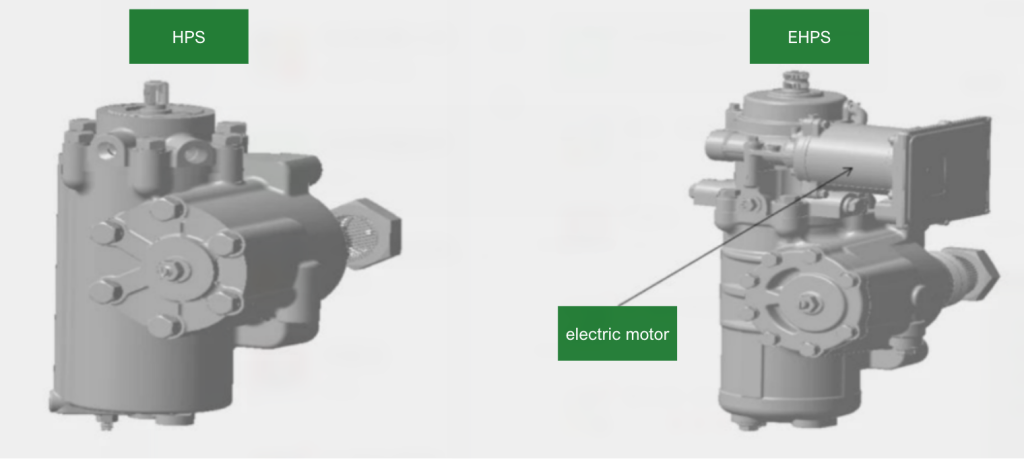
Electric Power Steering (EPS) removes the hydraulic system completely. An electric motor provides steering assistance directly. This eliminates pumps, tanks, and pipelines, which reduces weight and simplifies the system. EPS responds within milliseconds and delivers high control accuracy. Sensors capture steering wheel angle and torque, the controller calculates assist demand, and the motor delivers precise support. In light commercial vehicles, EPS commonly uses electric recirculating ball steering gears.
Next-Generation EPS: The Tie Rod EPS
The next important route is tie rod electric power steering (tie rod EPS). In this design, the motor drives a reduction mechanism, which moves a ball screw, then pushes the tie rod for linear motion to steer the wheels.
The advantages are clear: it meets the high torque requirements of commercial vehicles, provides precise control, and ensures reliability. Industry leaders have already advanced development:
- ZF introduced the ReAX EPS prototype in 2018 to support automation in trucks and buses.
- NSK showcased its motor + worm gear + ball screw solution at Auto Shanghai 2021, designed for high torque output.
- In China, a commercial bus completed 20,000 km of road validation using a tie rod EPS.
Industry consensus is strong: tie rod EPS will be the key technology for the next generation of commercial vehicle steering systems.
Diverse Innovations in Electric Steering Actuators
To meet the varied load demands of commercial vehicles, research and industry continue to explore innovative designs for electric steering systems.
Planetary Gear Electric Steering Actuator
- Structure: motor + cylindrical gear reduction + planetary gear + worm gear
- Feature: double reduction mechanism provides very high torque output, while worm gear transmits steering feel and road feedback.
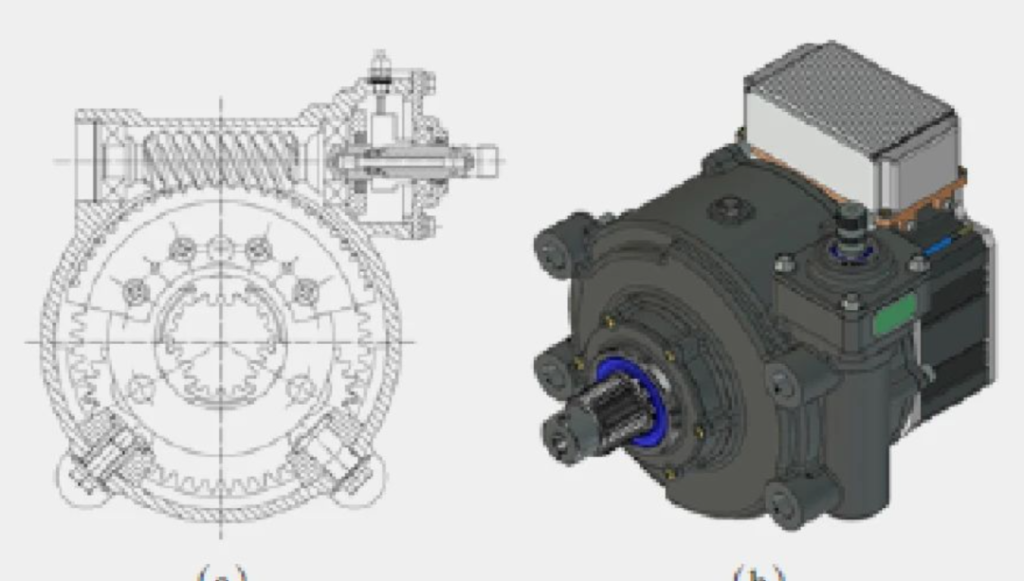
Cycloidal Pinwheel Electric Steering Actuator
- Structure: motor → cycloidal pinwheel reducer → spiral bevel gear reducer → steering input shaft
- Feature: compact and clever design, strong torque delivery, light and responsive handling.
Electromagnetic Assist Steering
- Structure: ECU controls current in DC coils → interacts with permanent magnets → drives nut of steering rack → rotates sector shaft
Feature: no traditional mechanical transmission chain, extremely fast response, new direction for future steer-by-wire systems.
Safety Redundancy in the Era of Autonomous Driving
Commercial Vehicle Steer-by-Wire Technology is a cornerstone for Level 4 and higher autonomous driving. To achieve reliability, redundancy is essential.
Current mainstream systems apply a dual-backup strategy: dual motors, dual controllers, dual sensors, and dual communication channels. This ensures continued function if one unit fails. Cutting-edge research explores cross-actuator redundancy at the vehicle level. In this method, actuators can compensate for each other to guarantee safety even if one fails. However, this approach requires highly complex algorithms and has not yet been widely commercialized.
The core challenge is finding balance between cost, system complexity, and safety. As the technology matures, redundancy strategies will play a central role in making steer-by-wire reliable for commercial deployment.
Technology Comparison and Application Outlook
| Technology Type | Core Features | Typical Vehicles | Smart Potential |
| EHPS | Electric pump driving hydraulic system; high compatibility | Medium and heavy trucks, buses, and new energy vehicles | Basic active control |
| EPS | Motor direct drive, no hydraulic parts | Light commercial vehicles | High-precision control |
| Tie Rod EPS | Linear motor drive, high torque | Medium and heavy trucks, buses | Core actuator for autonomous driving |
| Innovative Structures | Planetary, electromagnetic, or new transmission designs | Specific heavy-duty applications | Future technology reserve |
Industry Insight
Commercial vehicle steer-by-wire systems are still in a multi-path development stage. The choice of route depends on load capacity, axle configuration, cost, and maturity. But the direction is clear: full electrification, high-precision steer-by-wire, and deep integration with intelligent driving systems.
As redundancy design improves and costs fall, Commercial Vehicle Steer-by-Wire Technology will become a standard configuration. It will support unmanned freight transport, driverless buses, and future intelligent logistics.
 English
  Español
  Português do Brasil
  Türkçe
  日本語
日本語  Deutsch
  Français
  العربية
  한국어
한국어  Русский
  Italiano