¿Por qué los fabricantes de vehículos eléctricos comerciales adoptan una arquitectura de alto voltaje de 800 V y módulos de potencia de SiC? Este artículo ofrece una visión general, de carácter técnico pero orientada a las aplicaciones, de por qué los fabricantes de vehículos comerciales están adoptando arquitecturas de 800 V, cómo los módulos de SiC potencian las ventajas de los sistemas de alta tensión y qué mejoras cuantificables aportan estas tecnologías en los ejes eléctricos, los inversores, los sistemas térmicos y las operaciones de flotas.
¿Por qué 800 V?
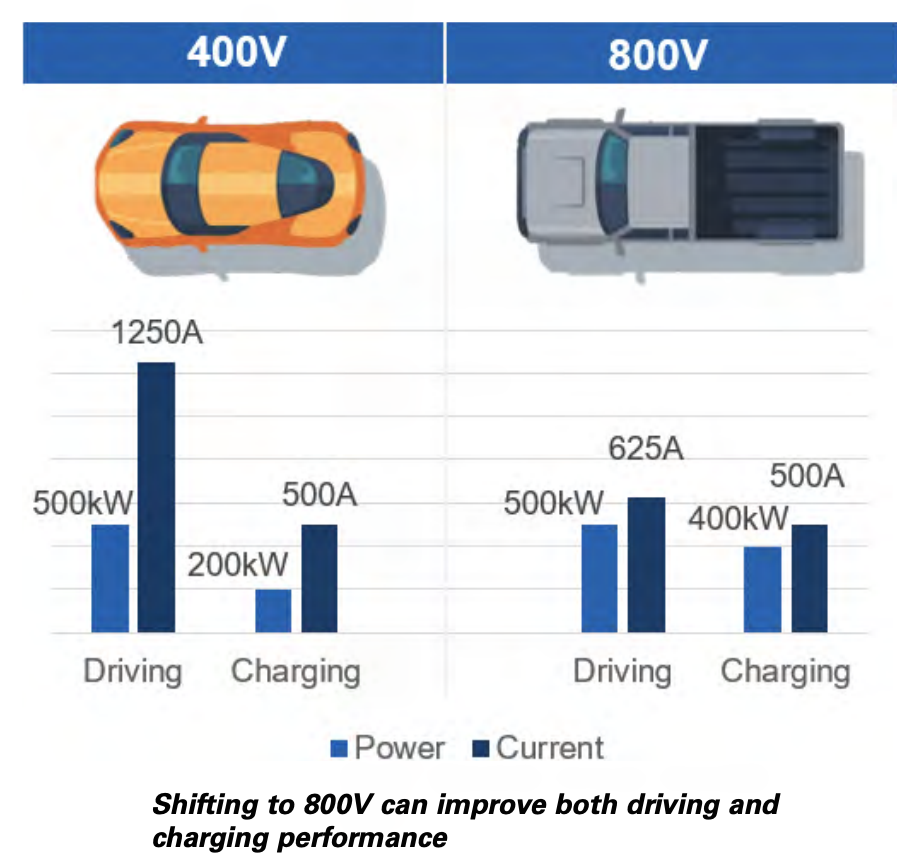
El nivel de tensión de un vehículo eléctrico influye directamente en la velocidad de recarga, la eficiencia y el rendimiento. En comparación con los sistemas tradicionales de 400 V, una arquitectura de 800 V ofrece claras ventajas para los vehículos eléctricos modernos.
Gracias a la tecnología de 800 V, los vehículos pueden admitir una recarga de corriente continua mucho más rápida. Con la misma intensidad de corriente, un vehículo eléctrico de 800 V puede recargarse con casi el doble de potencia que un sistema de 400 V, lo que reduce considerablemente el tiempo de recarga y mejora la disponibilidad del vehículo. Un voltaje más alto también mejora la eficiencia al reducir la corriente y las pérdidas de energía, lo que permite convertir más energía de la batería en autonomía de conducción.
Además, los sistemas de 800 V permiten utilizar componentes eléctricos más ligeros y compactos, lo que contribuye a reducir el peso del vehículo y a mejorar su rendimiento general. Al suministrar más potencia al motor de tracción eléctrico, las plataformas de alto voltaje también mejoran la aceleración y la capacidad de frenado regenerativo.
Módulos de potencia de SiC: el verdadero motor detrás de los 800 V
¿Por qué el SiC supera al IGBT de silicio tradicional?
Los inversores convencionales de 400 V se basan en módulos IGBT de silicio, pero estos dispositivos tienen dificultades para mantener la eficiencia de conmutación y la estabilidad térmica a medida que aumenta la tensión del sistema. Los MOSFET de SiC superan estas limitaciones gracias a una tensión de ruptura más alta, un rendimiento de conmutación más rápido, menores pérdidas por conducción y una capacidad superior a altas temperaturas. Cuando se integra en un inversor de 800 V, la tecnología SiC suele mejorar la eficiencia global de conversión de energía del tren de potencia entre un 5 % y un 81 %, reduce la generación de calor del inversor hasta en un 40 % y permite reducir el tamaño del sistema de refrigeración entre un 30 % y un 50 %.
| Parámetro | IGBT de silicio | MOSFET de SiC | Ventaja |
| Velocidad de conmutación | Bajo | Alta | Mayor eficiencia en el control del motor |
| Pérdida por conducción | Alta | Bajo | Menos calor, sistema de refrigeración más pequeño |
| Rango de tensión | Limitado | Excelente | admite 800-1200 V |
| Frecuencia de conmutación | Bajo | Alta | Reduce el ruido, las vibraciones y la dureza del motor |
| Rendimiento térmico | Moderado | Excelente | Permite un diseño compacto del inversor |
El SiC permite fabricar motores más pequeños, más rápidos y más precisos
Dado que el SiC admite frecuencias de conmutación mucho más altas, el inversor puede modular el par del motor con mayor precisión y menores pérdidas. Esto permite que los motores eléctricos funcionen a regímenes de revoluciones más elevados, al tiempo que se mantienen curvas de eficiencia más uniformes en diferentes condiciones de carga. A bajas velocidades, los inversores basados en SiC logran un control del par más suave y un mejor rendimiento NVH, lo que resulta especialmente valioso para autobuses y furgonetas de reparto que operan con frecuencia en entornos urbanos con paradas frecuentes. Una mayor eficiencia a baja velocidad se traduce directamente en una mayor autonomía en el mundo real.
El SiC aumenta la eficiencia del frenado regenerativo
Los vehículos comerciales acumulan una energía cinética considerable debido a su mayor peso bruto. Los MOSFET de SiC reducen las pérdidas por recuperación inversa durante la regeneración, lo que permite una mayor potencia de frenado regenerativo, intervalos de regeneración más prolongados y una menor acumulación de calor durante los ciclos de frenado repetidos. Las mediciones del sector sugieren que los sistemas de transmisión basados en SiC pueden recuperar entre un 5 % y un 121 % más de energía en operaciones urbanas, lo que supone un ahorro de miles de kilovatios-hora por vehículo al año.
Repercusiones a nivel de sistema en la arquitectura de los vehículos eléctricos comerciales
Mejoras en la eficiencia en todo el sistema de transmisión
Cuando las arquitecturas de 800 V se combinan con inversores de SiC, las ventajas se aprecian en todo el sistema de transmisión. Las pérdidas energéticas generales se reducen significativamente, el frenado regenerativo gana en eficacia, el paquete de baterías suministra energía de forma más eficiente y es posible reducir el tamaño tanto de los sistemas de refrigeración como de los cables de alimentación. Al mismo tiempo, el motor de tracción mantiene una mayor eficiencia en una gama más amplia de condiciones de funcionamiento. Las pruebas a nivel de flota suelen indicar mejoras de entre un 6 % y un 12 % en la eficiencia total del vehículo cuando se combinan estas tecnologías.
Diseños de ejes eléctricos más compactos y modulares
Los inversores de SiC impulsan la tendencia hacia sistemas de ejes eléctricos altamente integrados y compactos para camionetas eléctricas, furgonetas, monovolúmenes, camiones comerciales ligeros y autobuses. Su capacidad para admitir motores dobles, cajas de cambios de dos velocidades y conjuntos de reducción planetaria de alta eficiencia amplía el abanico de configuraciones que los fabricantes de equipos originales pueden implementar. Esta modularidad ayuda a los fabricantes a satisfacer diversos requisitos, como variantes 4×2 y 4×4, aplicaciones de remolque y transporte de carga pesada, todo ello en un paquete más compacto.
Reducción del tamaño de los sistemas térmicos
Las menores pérdidas de conmutación de los dispositivos de SiC reducen las temperaturas de unión, lo que permite utilizar refrigeradores más pequeños, caudales de refrigerante más bajos y una menor potencia de las bombas. Las plataformas de vehículos comerciales ligeros pueden prescindir de entre 8 y 15 kg de componentes térmicos, lo que contribuye a una mayor reducción de peso y a un ahorro energético. Para los operadores de flotas en entornos hostiles —como climas desérticos o regiones montañosas—, la menor carga térmica también mejora la fiabilidad a largo plazo.
Aspectos clave que deben tener en cuenta los fabricantes de equipos originales a la hora de implementar plataformas de 800 V
Requisitos del sistema de la batería
Los sistemas de mayor tensión requieren un mayor número de celdas conectadas en serie, un aislamiento mejorado, una protección HVIL optimizada, nuevas especificaciones para los contactores y circuitos de precarga revisados. Afortunadamente, las modernas tecnologías de baterías LFP y NCM ya admiten un funcionamiento a 800-1000 V, y los proveedores ofrecen cada vez más paquetes de baterías modulares compatibles tanto con plataformas de 400 V como de 800 V.
Compatibilidad de la infraestructura de recarga
Aunque muchos cargadores rápidos de CC comerciales funcionan actualmente a 400-500 V, los vehículos de 800 V pueden garantizar la compatibilidad mediante convertidores reductores CC/CC integrados o cargándose en estaciones equipadas con ajuste dinámico de tensión. En las cocheras de flotas, la corriente reducida de un sistema de 800 V disminuye la generación de calor en los cables y rectificadores, lo que reduce las necesidades de refrigeración y, en última instancia, reduce el coste de inversión de la infraestructura de recarga.
Arquitectura de control mejorada
Los sistemas de SiC de alta tensión requieren estrategias de control avanzadas, entre las que se incluyen una conmutación PWM más rápida, bucles de corriente de mayor frecuencia, algoritmos sofisticados de reducción de potencia por motivos térmicos, un control optimizado del controlador de puerta del SiC y una mayor mitigación de las interferencias electromagnéticas. Por lo tanto, las unidades de control de vehículos y las ECU de los inversores deben ser compatibles con la detección de corriente de gran ancho de banda, CAN FD o incluso el control basado en Ethernet para las plataformas de próxima generación.
Aunque los datos específicos de los fabricantes de equipos originales suelen ser confidenciales, los índices de referencia del sector ofrecen puntos de referencia. Un autobús urbano eléctrico de 12 metros que utiliza un sistema de propulsión de SiC de 800 V suele alcanzar una autonomía aproximadamente un 91 % mayor y reduce el peso del sistema de refrigeración entre 20 y 30 kg en comparación con un sistema IGBT de 400 V. Los camiones comerciales ligeros suelen experimentar una mejora del 10 % en la energía de frenado regenerativo y un aumento de la potencia máxima de carga de unos 300 kW a aproximadamente 420 kW. Las furgonetas de reparto de última milla logran reducciones del 7-8 % en el consumo de energía y acortan el tiempo de carga entre un 30 % y un 40 %.
Las arquitecturas de alta tensión de 800 V y los módulos de potencia de SiC representan dos de las tecnologías más importantes para la próxima década de desarrollo de los vehículos eléctricos comerciales. En conjunto, mejoran la eficiencia del sistema de propulsión, aceleran la recarga, reducen los costes operativos, mejoran el rendimiento térmico y permiten diseños de ejes eléctricos más compactos. Para los fabricantes de equipos originales y las flotas, la adopción de estas tecnologías no es una mera mejora técnica, sino una decisión estratégica que determina la competitividad en un mercado de vehículos eléctricos comerciales en rápida evolución.
Contacto Brogen - Proveedor líder de soluciones EV para vehículos comerciales
En Brogen, estamos especializados en el desarrollo y la producción de sistemas de tren motriz electrónico de alto rendimiento y sistemas de baterías para vehículos comerciales. Póngase en contacto con nuestros expertos en inquiry@brogenmotors.com.
Para conocer las últimas noticias, consulte Linkedin de Brogen. Para ver más vídeos, haga clic en Youtube de Brogen. Más información sobre Brogen soluciones ev para vehículos comerciales.

 English
  Español
  Português do Brasil
  Türkçe
  日本語
日本語  Deutsch
  Français
  العربية
  한국어
한국어  Русский
  Italiano