
Battery layout in electric heavy-duty trucks plays a critical role in vehicle performance, driving range, safety, cargo capacity, and total cost of ownership (TCO). As electric trucks become more common in commercial transportation, manufacturers are exploring different battery placement strategies to improve efficiency and operational reliability.
Today, three main battery layout solutions are widely used in the industry: rear-mounted batteries, bottom or side-mounted batteries, and mid-mounted batteries. Each layout has unique technical principles, advantages, and limitations.
This article analyzes these battery layouts from multiple perspectives, including technical logic, advantages and disadvantages, application scenarios, and future industry trends.
Rear-Mounted Batteries: A Cost-Effective Option for Short-Distance Operations
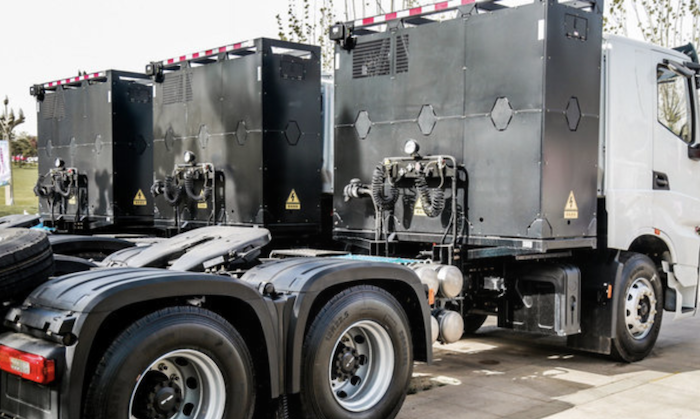
Rear-mounted batteries were the earliest battery layout used in electric heavy-duty trucks. This design typically modifies the chassis of traditional fuel or LNG trucks. The battery pack is installed behind the cab and mounted on the frame using dedicated brackets.
Because the original chassis structure remains largely unchanged, this layout allows manufacturers to convert fuel trucks into electric vehicles quickly and at a lower cost.
Principais vantagens
1. High battery swapping efficiency
Rear-mounted batteries support mature battery swapping systems. A battery replacement typically takes only 3–5 minutes, which allows trucks to maintain continuous operation. This is especially useful in environments with frequent trips and tight schedules.
2. Strong adaptability to harsh road conditions
The battery pack sits relatively high behind the cab. The chassis ground clearance usually remains above 280 mm, similar to traditional fuel trucks. This reduces the risk of battery damage when driving on rough roads in mines or construction sites.
3. Lower development and production costs
Rear-mounted layouts require minimal modifications to existing truck platforms. This shortens the development cycle and reduces R&D investment. As a result, vehicles using this layout can be 10–20% cheaper than models built on dedicated electric platforms.
Key Limitations
1. Reduced cargo space and limited visibility
The battery pack behind the cab blocks the rear window view. This increases blind spots during reversing or turning. In addition, the battery occupies space between the tractor and trailer, which may limit compatibility with certain long trailers.
2. Higher center of gravity
The battery pack’s center of gravity is typically 1.5–1.8 meters above the ground. This is much higher than bottom-mounted layouts. As a result, vehicle stability may decrease during high-speed driving or when carrying heavy loads.
3. Limited battery capacity and range
Due to space limitations, rear-mounted battery packs usually have capacities of 200–300 kWh. In real-world conditions, the driving range is typically 150–200 km, which makes it unsuitable for long-distance transportation.
Typical Application Scenarios
Rear-mounted battery electric trucks are commonly used in:
- Mining site transportation
- Port container transfer
- Steel plant or power plant logistics
These scenarios involve short distances, high-frequency trips, and controlled environments.
Bottom or Side-Mounted Batteries: The Best Solution for Long-Range Transport
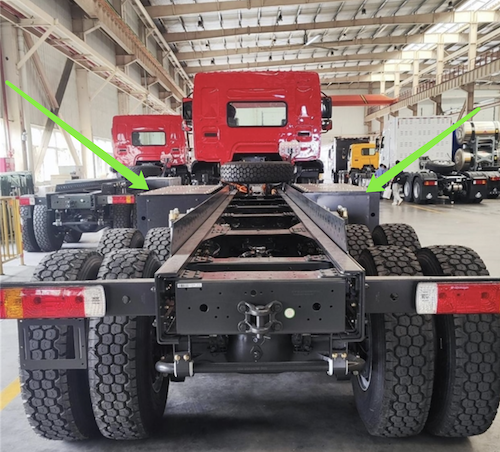
Bottom-mounted and side-mounted battery layouts are typically used in trucks designed on dedicated electric platforms. Instead of placing the battery behind the cab, the battery pack is integrated into the chassis.
In bottom-mounted designs, the battery is installed beneath the frame. In side-mounted layouts, battery modules are distributed along both sides of the chassis. Some vehicles combine both configurations to maximize capacity.
Principais vantagens
1. Higher cargo capacity
Without a battery pack behind the cab, trucks can fully utilize the chassis space and connect to standard 13-meter trailers. Cargo capacity can increase by over 9% compared with rear-mounted layouts.
2. Lower center of gravity
The battery pack is positioned closer to the ground, usually with 180–220 mm clearance. This lowers the vehicle’s center of gravity by more than 30%, improving stability during high-speed driving and heavy loading.
3. Larger battery capacity and longer range
Bottom-mounted battery systems allow larger battery modules. Many trucks can support 513 kWh or even 600 kWh battery packs, providing a driving range of 500–600 km under real-world conditions.
This makes the layout ideal for long-distance freight transport.
Principais desafios
1. Expensive battery swapping infrastructure
Battery swapping systems for bottom or side-mounted batteries require specialized lifting equipment. The cost of building a battery swapping station can exceed 5 million RMB, which is about 2.5 times higher than rear-mounted stations.
2. Higher protection requirements
Since the battery pack is located lower on the chassis, it faces greater risks from road debris, gravel, or uneven surfaces. Additional protective plates are often required, which increases vehicle weight.
3. Higher vehicle cost
Dedicated electric truck platforms require significant R&D investment. This can increase the vehicle price by 15–25% compared with converted electric trucks.
Typical Application Scenarios
Bottom or side-mounted battery electric trucks are commonly used in:
- Long-distance trunk logistics
- Cold chain transportation
- Intercity freight distribution
These operations require long-range, high-efficiency, and stable driving performance.
Mid-Mounted Batteries: A Practical Solution for Light Trucks
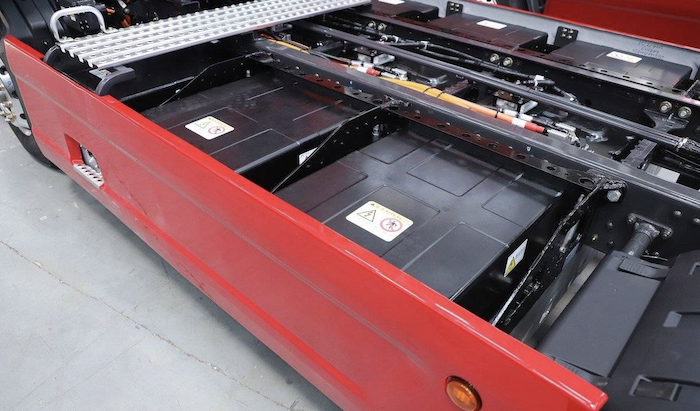
Mid-mounted batteries are mainly used in electric light trucks and special-purpose vehicles. In this design, the battery pack is installed in the middle section of the chassis between the frame crossbeams.
This layout balances vehicle stability, space efficiency, and maintenance convenience.
Principais vantagens
1. Balanced weight distribution
Placing the battery in the middle of the chassis ensures more balanced left-right weight distribution. The center of gravity remains relatively low while maintaining adequate ground clearance.
2. Improved side collision protection
The battery pack is surrounded by the chassis structure. This provides better protection during side impacts and reduces the risk of battery damage in urban driving conditions.
3. Easier maintenance
Because the battery pack is centrally located, technicians can access it more easily during maintenance. It also allows flexible adjustments to battery capacity or vehicle body configurations.
Key Limitations
1. Limited battery capacity
Due to the smaller chassis size of light trucks, battery capacities are typically 80–150 kWh. The driving range usually falls between 100 and 200 km.
2. Restricted scalability
Mid-mounted battery layouts have limited expansion space. This makes it difficult to install larger batteries for long-distance operations.
Typical Application Scenarios
Mid-mounted battery electric trucks are widely used in:
- Urban logistics distribution
- Express delivery vehicles
- Electric sanitation trucks
- Refrigerated light trucks
These vehicles mainly operate within cities and travel shorter distances.
Frequently Asked Questions (FAQ)
1)What is the best battery layout for electric heavy-duty trucks?
The best battery layout depends on the transportation scenario. Rear-mounted batteries are suitable for short-distance operations with frequent battery swapping. Bottom or side-mounted batteries are better for long-distance transport because they support larger battery capacity and longer driving range.
2)Why do long-distance electric trucks use bottom-mounted batteries?
Bottom-mounted batteries lower the vehicle’s center of gravity and allow larger battery packs. This improves driving stability, cargo capacity, and overall range, which are essential for long-haul logistics.
3)Are rear-mounted batteries still widely used?
Yes. Rear-mounted battery layouts are still common in controlled environments such as mining sites, ports, and industrial facilities. They provide lower vehicle costs and faster battery swapping.
Future Trends in Electric Truck Battery Layout
Several industry trends are shaping the future of battery placement in electric trucks.
Battery swapping standardization is accelerating, which will allow different vehicle models to share battery swapping infrastructure.
Advanced battery protection systems are also being developed. These include composite protective plates, radar-based road detection, and adaptive suspension systems.
Finally, integrated battery and chassis designs are becoming more common. In these designs, the battery pack becomes part of the vehicle structure. This reduces weight while improving safety and structural strength.
Conclusão
Different battery layouts in electric heavy-duty trucks are designed for different transportation scenarios.
- Rear-mounted batteries provide a cost-effective solution for short-distance operations.
- Bottom or side-mounted batteries support long-range transportation and higher cargo efficiency.
- Mid-mounted batteries offer a practical solution for electric light trucks and specialized vehicles.
When selecting an electric truck, fleet operators should evaluate their transportation routes, energy infrastructure, and operating costs to choose the most suitable battery configuration.
 English
  Español
  Português do Brasil
  Türkçe