
As businesses around the world accelerate their carbon reduction strategies, many are investing in electric and hybrid vehicles. Some fleets are fully electric, while others incorporate electrified systems such as eixos elétricos to reduce dependence on fossil fuels. By electrifying part or all of a vehicle’s powertrain—the system responsible for converting fuel or electricity into motion—companies can transition toward lower-carbon transport solutions.
With the rapid expansion of the electric vehicle e-axle market, this integrated technology is becoming a core enabler of next-generation mobility. Here’s what you need to know about eAxles and how evolving eAxle design will shape the future of commercial transportation.
The Shift Toward Electrified Powertrains
Modern engineering has successfully electrified many transport and logistics applications. Today’s EVs deliver the performance and load capacity needed to compete with traditional diesel-powered vehicles, achieving near parity with internal combustion engine (ICE) models in many duty cycles.
While last-mile delivery fleets have widely adopted EVs, long-haul and heavy-duty transport still face charging infrastructure and cost barriers. Although long-range electric trucks are emerging, upfront vehicle costs remain a challenge for many operators. As a result, hybrid platforms and modular electrification strategies are gaining traction—particularly those built around scalable eixo de acionamento elétrico systems.
O que é um eixo de acionamento elétrico?
To understand the concept of an eAxle, it helps to review the function of a traditional axle.
In a conventional powertrain, five main components work together: engine (or motor), transmission, driveshaft, differential and axles. The axle supports the vehicle’s weight and transfers torque to the wheels.
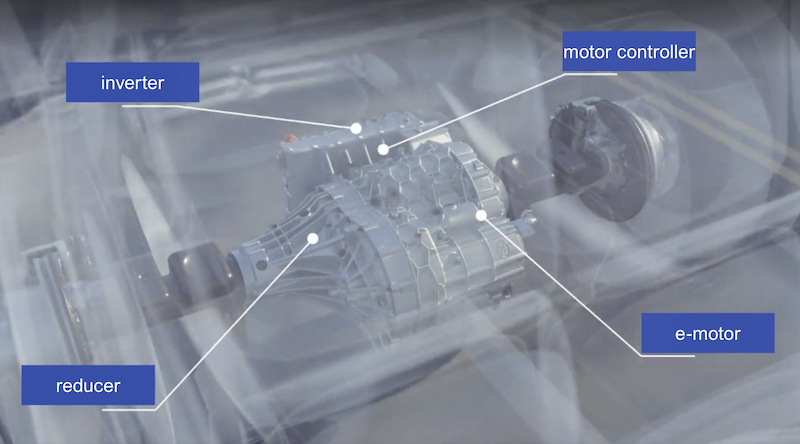
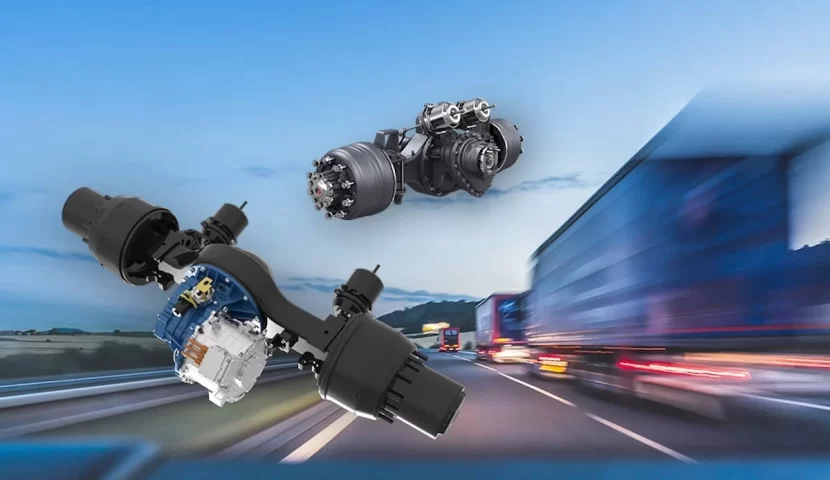
Um eixo de acionamento elétrico integrates multiple traditional drivetrain elements into a single compact unit. Instead of separate motor, gearbox and differential systems, modern electric axle components combine these functions within the axle assembly itself.
This integrated eAxle design improves packaging efficiency, enhances driveline performance and simplifies vehicle architecture—making it ideal for both hybrid and fully electric commercial vehicles.
How Electric Axles Are Powered?
Most eAxles draw energy from lithium-ion battery systems. Depending on load requirements and vehicle size, an electric axle may incorporate one or two motors to deliver the necessary torque output.
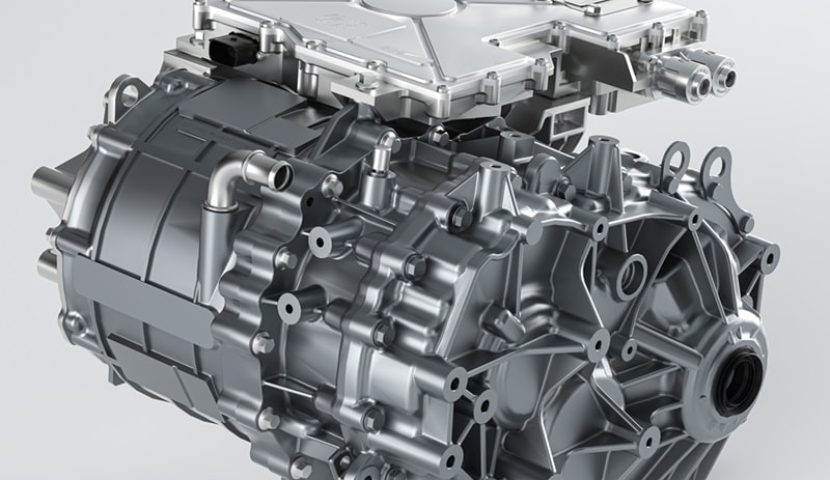
Advanced electric axle components, including the motor, inverter and transmission, are often integrated into a single housing. This consolidation reduces overall weight compared to traditional multi-component drivetrains and improves system efficiency.
Motor Options for eAxles
Different motor technologies are used within the electric vehicle e-axle market, including:
Permanent Magnet Synchronous Motors (PMSM)
Known for high efficiency and power density, ideal for demanding commercial applications.
Induction Motors
Cost-effective and durable, though typically offering slightly lower efficiency.
Switched Reluctance Motors
Simple and robust design with good efficiency, though generally lower torque density.
In addition to motor selection, overall eAxle design plays a critical role in performance. Integrated systems reduce mechanical drag, optimize torque delivery and enhance regenerative braking efficiency.
Fuel Cell Applications in eAxle Systems
Beyond batteries, hydrogen fuel cells are emerging as a viable power source for zero-emission transport. Fuel cells generate electricity through an electrochemical reaction between hydrogen and oxygen, producing only water and heat as byproducts.
As hydrogen infrastructure expands, fuel cell-powered eixo de acionamento elétrico systems may become more prevalent—especially in heavy-duty and long-range transport segments.
Key Benefits of Electric Drive Axles
The rapid growth of the electric vehicle e-axle market is driven by the substantial benefits eAxles provide:
- Simplified integration through consolidated electric axle components
- Improved driveline efficiency and reduced mechanical losses
- Enhanced regenerative braking performance
- More compact packaging within the chassis
- Additional space for battery placement inside frame rails
- Reduced noise and vibration
- Instant torque response for improved driving dynamics
- Lower maintenance requirements compared to conventional drivetrains
By integrating propulsion components into a single modular unit, modern eAxle design improves serviceability and reduces system complexity.
Future-Proofing Commercial Fleets
For many businesses, replacing entire fleets with new EV platforms is not economically feasible. Retrofitting or upgrading existing vehicles with an eixo de acionamento elétrico offers a practical and cost-effective pathway toward electrification.
Modular architectures within the growing electric vehicle e-axle market allow OEMs and fleet operators to deploy scalable solutions across multiple vehicle configurations—whether electric, series hybrid or plug-in hybrid.
As electrification technology advances, optimized electric axle components and next-generation eAxle design will continue to reduce fuel dependence, improve operational efficiency and accelerate the transition toward sustainable transportation.
Converse com a equipe da Brogen
Entre em contato com nossos especialistas em inquiry@brogenmotors.com. Para obter as últimas notícias, consulte Linkedin da Brogen. Para mais vídeos, clique em Youtube da Brogen. Saiba mais sobre a Brogen's soluções ev para veículos comerciais.
- Tecnologia Steer-by-Wire para veículos comerciais: Caminho para sistemas de direção inteligentes
- BYD e-Bus Platform 3.0 com arquitetura de 1000V e sistemas avançados de ônibus elétricos
- Como projetar um conjunto de baterias para máquinas de construção?
- Qual é o melhor sistema de acionamento de caminhão elétrico para serviços pesados?
- Qual é o melhor layout de bateria para caminhões elétricos de carga pesada?
 English
  Español
  Português do Brasil
  Türkçe