How does a Vehicle Control Unit (VCU) work?
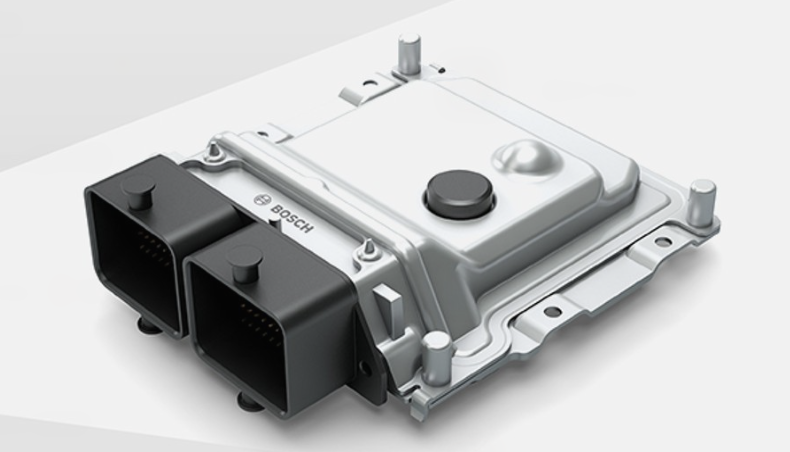
O Vehicle Control Unit (VCU) serves as the central brain of a new energy vehicle’s control system. It collects driver and system input signals, coordinates multiple subsystems, sends out control commands, and continuously monitors the entire vehicle to ensure safety, efficiency, and performance.
The VCU communicates in real time with key components such as the Motor Control Unit (MCU) e Battery Management System (BMS) via the CAN bus. It translates the driver’s intentions—like pressing the accelerator or selecting a driving mode—into precise torque and energy control commands while constantly monitoring operating status.
Types of Vehicle Control Units
VCUs can be classified according to their specific functions and the type of vehicle they serve. The most common categories include:
- Powertrain Control Unit (PCU): Oversees the engine and transmission systems in internal combustion engine (ICE) vehicles.
- Electric Drive Control Unit (EDCU): Controls motor torque and speed in electric and hybrid vehicles.
- Battery Management System (BMS): Monitors and manages the safe charging and discharging of the vehicle’s battery pack.
- Chassis Control Unit (CCU): Regulates critical functions such as vehicle stability, steering, and braking.
- Body Control Module (BCM): Handles auxiliary systems including lighting, climate control, and vehicle security.
Each type of VCU works in coordination with other Electronic Control Units (ECUs) to deliver integrated and intelligent vehicle operation.
Core Functions of a Vehicle Control Unit
1. Drive Control and Energy Management
The VCU interprets signals from the accelerator and brake pedals to determine driver intent and control motor torque output. It ensures smooth acceleration, braking, and regenerative braking — the foundation of EV performance.
2. Energy Optimization
To maximize driving range, the VCU manages how the motor consumes and regenerates energy. During braking, it enables the motor to act as a generator, converting kinetic energy into electricity and recharging the battery when possible.
3. High-Voltage System Management
It controls vehicle power-on and power-off sequences through pre-charge relays to prevent current surges and ensure safety. In case of critical faults, such as battery overvoltage or motor overheating, the VCU instantly cuts off high-voltage power while maintaining low-voltage systems like steering and braking assist.
4. Thermal Management Coordination
The VCU integrates temperature control across the battery, motor, e HVAC systems. For example, in winter it prioritizes battery heating before cabin comfort; in summer it manages cooling fans and coolant systems to prevent overheating.
5. Status Monitoring and Fault Diagnosis
Constantly analyzing data from sensors and ECUs, the VCU detects faults and displays warnings on the instrument panel. When severe issues like high-voltage leakage occur, it triggers automatic safety responses to protect both the vehicle and passengers.
6. Driving Modes and Functional Control
The system supports multiple drive modes—Eco, Sport, e Snow.
- Sport Mode: Delivers maximum torque and performance.
- Eco Mode: Prioritizes energy efficiency and extended range.
- One-Pedal Mode: Engages strong regenerative braking when the accelerator is released.
VCU System Architecture
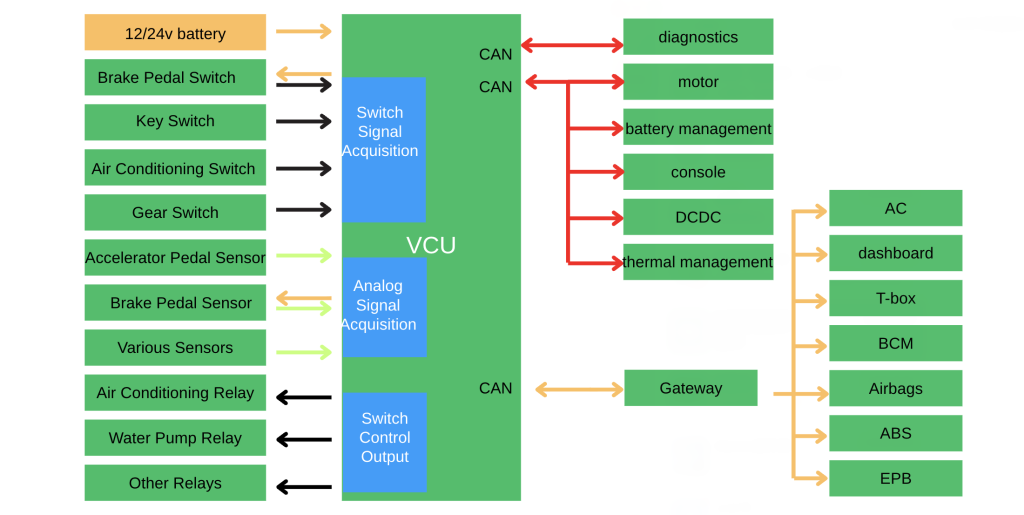
A typical VCU connects to:
- Power and signal interfaces (switch and analog inputs)
- Output control circuits
- Multiple CAN communication channels:
- One for diagnostics and calibration
- One for powertrain ECUs (often high-speed communication)
- One for electric subsystem ECUs
This multi-channel setup ensures fast, reliable communication between all vehicle systems.
Future Trends in VCU Development
In the wave of electronic and electrical architecture transformation, VCUs are gradually moving towards integration and domain control. Integration and domain control are the future development directions, improving efficiency and reliability through integrated functions and using high-performance chips to achieve a vehicle service architecture. Integration refers to consolidating some functions of the vehicle control system into a single controller. Domain control is a further upgrade of integration technology, which transforms the VCU into the domain control center of the power domain, and with the support of high-performance chips, realizes the construction of the vehicle’s SOA service architecture.
Entre em contato com a Brogen - líder no fornecimento de soluções de EV para veículos comerciais
Na Brogen, somos especializados no desenvolvimento e na produção de sistemas de e-powertrain de alto desempenho e sistemas de baterias para veículos comerciais. Entre em contato com nossos especialistas em inquiry@brogenmotors.com.
Para obter as últimas notícias, consulte Linkedin da Brogen. Para mais vídeos, clique em Youtube da Brogen. Saiba mais sobre a Brogen's soluções ev para veículos comerciais.
 English
  Español
  Português do Brasil
  Türkçe